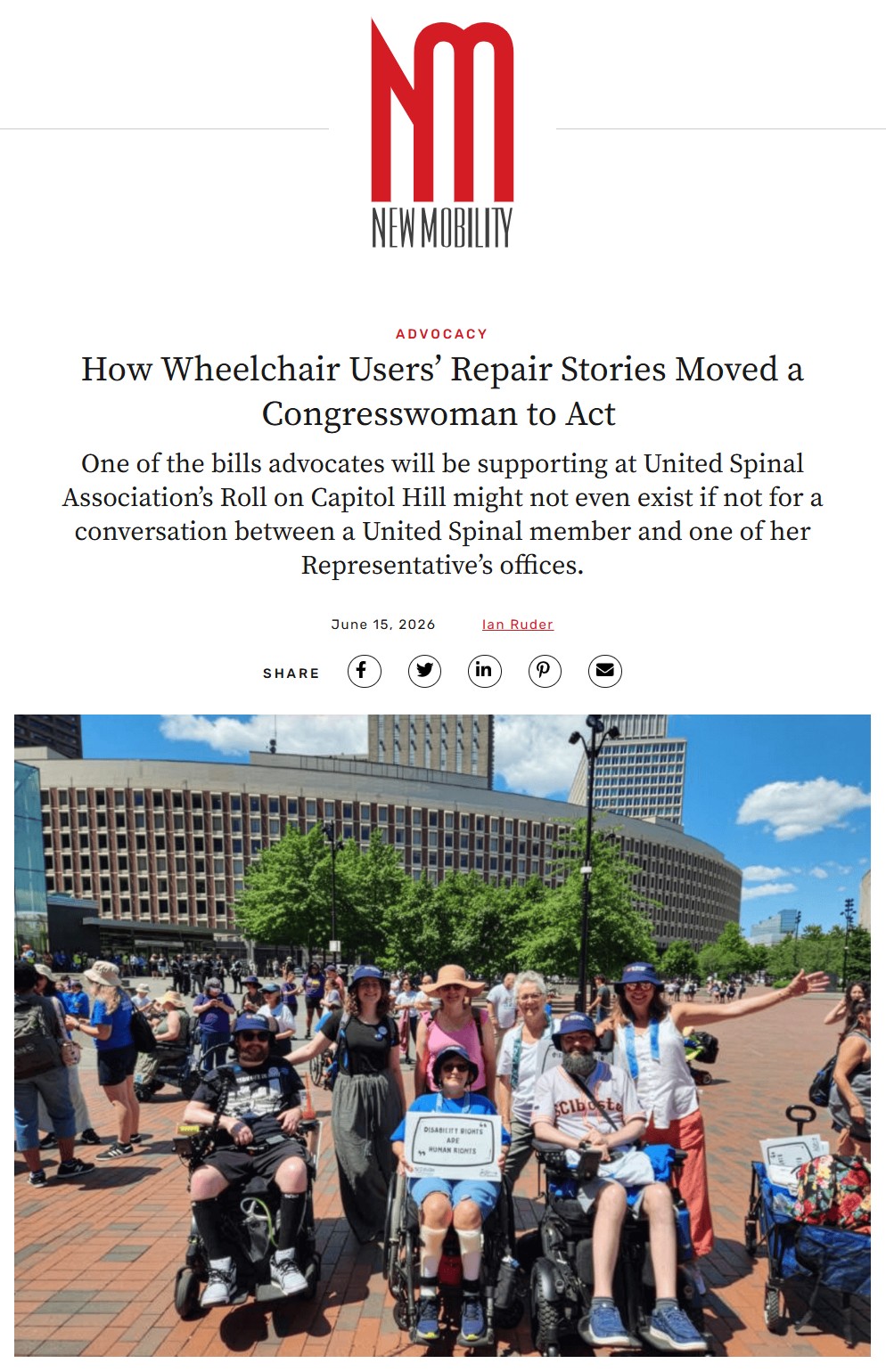
 | | This week, Congresswoman Ayanna Pressley introduced the Facilitating Access to Service and Timely (FAST) Repairs for Wheelchairs Act, a bill that would eliminate prior authorization requirements for wheelchair repairs under Medicare Advantage plans – including One Care plans, which combine Medicare and Medicaid for dually eligible individuals. Notably, traditional Medicare already does not require prior authorization for these repairs. What’s especially special about this legislation is that it wouldn’t have been possible without advocacy from SCIboston members. Pam Daly, William Good, and myself (Vita Brown), shared stories of wheelchair repair challenges at a virtual United Spinal Association Roll on Capitol Hill event last year. Congresswoman Pressely’s office heard these stories and decided to take action. This year, they reached out to us for our input on a new bill – what then became the FAST Repairs for Wheelchairs Act. We met with Congresswoman Pressley, along with Dianna Hu and Dr. Chloe Slocum, to discuss some of the challenges surrounding wheelchair repairs. You will be able to see excerpts from these conversations in the upcoming weeks on Congresswoman Pressley’s social media pages. Pam Daly and I were also interviewed for the United Spinal Association blog and by New Mobility Magazine. This proves what’s possible when you speak up and share your story. Now it’s your turn. Take a moment to reach out to your congressional offices and tell them you support the FAST Repairs for Wheelchair Act. Find your legislator here. And don’t forget to keep up the momentum by sharing your own wheelchair repair challenges on social media. |
|
|
|  | Source: New Mobility Magazine, 2026 |
|
|
| | Advocate Spotlight! In the most recent advocacy blog post, Justin Graceffa takes us on a journey of perseverance and resilience, turning personal hardship into passion and progress, and becoming a voice for all who use the PCA program. He tells a story of how any of us can show up – first for ourselves, and then for the community. In his essay, Justin shares what brought him to join the PCA Workforce Council and of his first few years as a member. Justin is the PCA Workforce Council’s Vice Chair. He is also a peer mentor with SCIboston, an artist, a power wheelchair user, and a person living with a spinal cord injury. Justin sustained his injury in 2007 after a fall from a third-story balcony and has relied on PCA services for more than 18 years. Through his own experiences navigating challenges within the PCA program, Justin developed passion for advocacy work. His involvement has given him the opportunity to share his lived experience and perspective with state administration officials and MassHealth leadership. Through this work, he continues to help shape the future of the PCA program and advocate for policies that better support people with disabilities. Anyone can apply to join a board, commission, council or task force. A position on these bodies offers a chance to directly influence change, as they are often made up of only a few members and act as a link between governing bodies and the greater community. If this seems like a way in which your advocacy would shine, click here to be directed to a list of boards and commissions with open seats. Read Justin Graceffa’s blog post, “From Self-Advocacy to Community Leadership: A Story of Impact” here. |
| Big Changes to Medicaid: Last July, as part of H.R. 1 (aka the Big Beautiful Bill Act), Congress passed new work requirements for people receiving Medicaid. The Centers for Medicare and Medicaid Services (CMS) has now issued an Interim Final Rule* (IFR) that explains how states must implement these new work requirements. This IFR explains what “community engagement activities” meet the work-requirement standards and defines who qualifies for exceptions – such as family caregivers or people who are “medically frail”**. It also tells the states how they must verify these work requirements and exceptions. However, this IFR takes it a step further and in order to qualify as “medically frail” an individual must also prove that their condition significantly impairs their ability to meet the work requirements. Providing proof for these requirements will create unnecessary hurdles for people, risking their loss of Medicaid coverage despite being eligible. Read more from Politico here. Submit a comment on the IFR by July 31, 2026 |
|
|
| *An IFR is like a final draft of a policy – people get a chance to submit comments to the things they want changed before the draft is finalized and published. **“Medically frail” is not typically used in the disability community, but is the term used in H.R. 1 and describes individuals who are blind or disabled (under the definition in the Social Security Act), or who have a substance use disorder, a serious or complex medical condition, or have a physical, intellectual, or developmental disability that significantly impairs one or more activities of daily living (ADLs). |
| |
|
| Can’t see your doctor in person? No problem! Telehealth coverage for Medicare recipients has been extended through December 31, 2027! Learn more here. |
|
|
| | - Protect Health Care Equity! Contact the Senate Ways & Means Committee before July 31st to move the healthcare anti-discrimination bill (S.869) forward and ensure equitable care for all.
- Call Governor Healy and tell her PCAs need a Raise! The PCA union, 1199SEIU is currently bargaining for a new contract for Personal Care Assistants that includes a yearly cost of living raise, a healthcare fund to help with health insurance premiums, and the implementation of retirement security that was won with the last contract in 2023. Call Governor Healy to tell her PCAs need a raise at (617) 725-4005.
- Share your experience as a parent with a disability! The National Research Center for Parents with Disabilities invites disabled parents to submit blog posts about their experiences or videos of problem solving ‘life hacks’. Click here for more information and to submit your post.
- Join a Riders’ Transportation Access Group (RTAG) working group! RTAG has four working groups, based on key areas: Blind and Low-vision Accessibility Working Group, Municipal Coordination Working Group, Community Outreach and Engagement Working Group, and The RIDE Working Group. Please sign up for any of these groups by filling out the form here.
- Nominate an advocate (or yourself!) to share your experiences at the Spinal Cord Injury Patient-Focused Drug Development (SCI PFDD) meeting. This meeting will bring together people with spinal cord injuries and their caregivers, members from the FDA and other key stakeholders to ensure that new treatments better reflect the priorities of people living with SCI. Submit your nomination by June 22nd.
|
| | Local Opportunities: - Massachusetts Senior Action Council (MSAC) wants to hear about how recent RIDE policy changes have affected riders. Fill out the survey here: RIDE Survey
- Help shape local adaptive sports and recreation programs! The Boston Self Help Center is expanding its programs beyond Power Wheelchair Soccer. Take the survey here.
- Tell the Disability Law Center (DLC) which issues matter most! DLC and other disability advocacy organizations are facing possible funding cuts. They need your help to make sure they are focusing on what the disability community needs. Take the survey! Prefer to tell them in person or on Zoom? Click here for a list of dates and locations.
- Influence the direction for the next State Plan for Independent Living for the Massachusetts Statewide Independent Living Council. Your input will help set goals for independent living services, guide advocacy, and improve public outreach and education! Take the Needs Assessment survey here.
|
| National Opportunities: - Help improve accessible air travel! The Federal Aviation Administration (FAA) is gathering feedback to further understand the challenges and opportunities for improving air travel accessibility. Please complete the survey by June 25th. Click here to take the survey.
- The Kessler Foundation is seeking to understand wheelchair breakdowns and how repair experiences differ across racial and ethnic backgrounds. Interested in participating? Check out the flyer for more information.
|
|  | Photo courtesy of the Christopher & Dana Reeve Foundation and Adam Shea Photography |
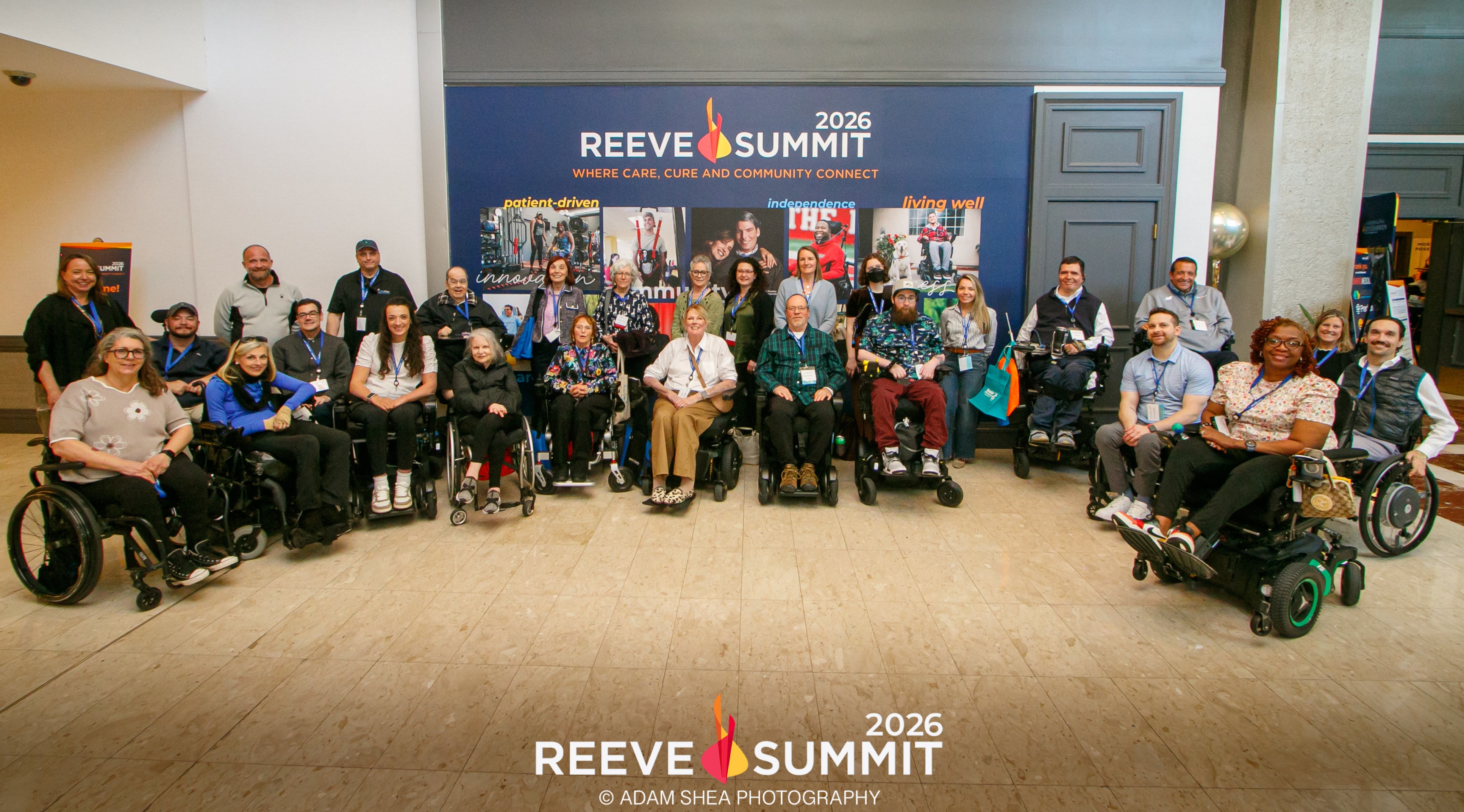
| 2026 Reeve Summit: A Defining Event for Advocacy and Collaboration The 2026 Reeve Summit (Boston, MA, May 6–8) united advocates, healthcare leaders, and policymakers to drive progress for the paralysis community. Led by keynote speaker Marissa Bode and emceed by Ali Stroker, the summit featured our community members as panelists and session contributors, shaping the agenda with their expertise. Sessions covered aging with paralysis, adaptive sports, caregiving, and policy, highlighting actionable solutions for real-world impact. SCIboston was proud to participate by sponsoring 20 community members’ attendance, ensuring the voices of people with SCI and their loved ones were front and center. A Community Member’s Perspective By Judi Downey When I found out that the 2026 Reeve Summit would be held in Boston this year, I couldn’t wait to attend. I am always eager to expand my learning to become a better care partner and mentor and enhance my interactions with those with disabilities. This year’s theme was “Where Care, Cure and Community Connect,” and that is exactly what happened over those three days. Continue reading here. |
|
|
| | Disability History: In 1978, they stopped buses — and helped launch a disability rights movement, NPR Medical Appeals:Recent Victory in Appeal for Coverage of Rolling Shower Chair, CMA AI: How Artificial Intelligence Is Reshaping Work for Americans with Disabilities, AEI SSI: Why the Supplemental Security Income (SSI) Asset Limit Must Go, Justice in Aging Parking: Advocates Urge More Parking Access for All, Challenge Florida Law Impacting Disability Spaces, United Spinal Accessibility: How to Advocate for Better Accessibility at Festivals and Other Public Venues, United Spinal Medicaid: How H.R. 1 Impacts People Dually Eligible for Medicare and Medicaid, Justice in Aging Housing: Disability Community Celebrates Accessible Affordable Housing Victory, Business West Elevators: Boston Housing Authority faces ‘rare’ fine from state board after years of elevator issues, GBH |
|
|
| | Wednesday, June 24th: - United Spinal Association’s annual Roll on Capitol Hill. This virtual event is an opportunity to build connections with your members of Congress and advocate for the SCI community. You must be a grassroots advocate to attend. Please register for the event here.
SAVE THE DATE: Wednesday, July 15th: - Join us for Boston ADA Day, from 12:00 - 2:00 PM, Copley Square.
|
| | Voting with a Disability: |
|
|
| From the United Spinal Association: |
|
|
| Advocacy 101: Interested in expanding your advocacy knowledge? Head over to United Spinal Association’s website to take their first module: Why Advocacy? You’ll learn a history of disability related advocacy, important definitions, and ways to be a more successful advocate. Click here to take the course. It will take 45 minutes or less to complete. |
|
|
Join the United Spinal Association Advocacy Hub, an all new Facebook Group for advocates around the country to collaborate and engage with each other. |
|
|
| | We rely on donations, sponsors and grants to fund our advocacy program. If we have made a difference in your life or that of someone you love, consider a donation to allow us to continue to assist others as we assist you. |
| |
|
| | Contact Us SCIboston
2 Rehabilitation Way
Woburn, Massachusetts 01801
(617) 952-5643
[email protected] |
|
|
| SCIboston
2 Rehabilitation Way | Woburn, Massachusetts 01801
(617) 952-5643 | [email protected] |
|
|
| | |
|
|