 | Shutdown Shut Down: The government shutdown ended on November 12th with the passage of a continuing resolution, funding the federal government through January 30th, 2026. Some agencies, such as the Department of Agriculture (SNAP), Food and Drug Administration, Veteran Affairs, and the legislative branch, will be funded for the full fiscal year through September 2026. The resolution also protects federal workers from layoffs until January 30th and reversed the more than 4,000 layoffs that occurred during the shutdown, including staff that were fired from the Department of Education in the Office of Special Education Programs (OSEP), Rehabilitation Services Administration (RSA), and the Office for Civil Rights (OCR). SNAP: The continuing resolution fully funds SNAP through September 2026, helping protect the program from future shutdowns or delays. While this is good news, we also recognize that the lack of SNAP during the shutdown has had a profound and ongoing impact on members of our community, with 300,000 Massachusetts residents with disabilities receiving SNAP benefits, and PCAs being some of the highest population of workers who rely on SNAP. Food pantries were forced to distribute far more food last month than usual and are still struggling to keep up with the surge in demand. For example, the Greater Boston Food Bank distributed more than 500,000 additional pounds of food in the first week of November compared with the same period last year (NYT). Donations of food and funds are greatly needed. Both food and financial donations are urgently needed. If you or someone you know needs food assistance, please visit the resource linked here. LIHEAP: Funds for the Low Income Home Energy Assistance Program (LIHEAP) were also reinstated with the end of the shutdown, however, the funds were not disbursed until the first week of December. LIHEAP assists nearly 160,000 Massachusetts households in paying for heating their homes. Due to the shutdown, the Massachusetts Department of Public Utilities (DPU) has extended the heating shut-off moratorium for major gas and electric utilities by a month (now October 27th to April 1st). If you are struggling to heat your home, or need other assistance with utilities, check out some of the below resources or contact your utility to learn about any offered assistance programs. Apply for LIHEAP here. |
| | Big Changes Coming to the MassHealth PCA program: Beginning January 1st, 2026, the MassHealth PCA program will undergo several important changes – including some new benefits for consumers and PCAs. Below is an overview of some of the most significant updates. Complex Care Wage Differential: People who require assistance with enteral tube feedings or digital rectal stimulation may qualify for a new complex care rate. PCAs who work for eligible consumers will receive an additional $3.25 an hour. To ensure your PCAs receive this pay increase, confirm that your PCM agency has all the required documentation. New Hire Paperwork: Beginning next spring, all new hire paperwork must be completed before a PCA can receive a PCA ID number and begin working. PCAs will no longer be able to be paid retroactively for hours worked before their paperwork is approved. “Difficulty of Care” Tax Exclusion: PCAs who live in the same home as the consumer they support may now have their PCA earnings treated as tax-free “difficulty of care” payments – meaning no federal or state income tax on those wages. Applications will be processed on a rolling basis. Other Program Changes: Other changes include updates to CORI/SORI checks, the Consumer Handbook, minimum PCA age, EVV for live-in PCAs, overtime rules, and weekly hour limits. You can read more about each of these changes, as well as the full list here. |
| | Big Changes to One Care: Due to recent federal policy changes – specifically, the Centers for Medicare & Medicaid Services’ decision not to continue One Care as a demonstration program under the Affordable Care Act – One Care plans will no longer be required to cover several services that were previously provided. These changes will take effect beginning in January 2026. |
| Several benefits may be affected, including: - PCA services
- Respite services
- Assistive and Adaptive technology
- Home-delivered meals
- Chore and homemaking services
- Cueing and monitoring for PCA services
- Non-medical transportation
- Home modifications, and other related supports
|
|
|
| It is very important for you to reach out to your care manager to discuss how these changes may affect you. You may also contact SHINE at 1-800-243-4636 for help with picking a plan that best suits your needs or My Ombudsman at 1-855-781-9898 for more information. |
|
|
| In addition to the benefit changes, there will be two new One Care insurance providers. Previously, the available plans were Point32Health (Tufts), UnitedHealthcare (UHC), and Commonwealth Care Alliance (CCA), which was recently purchased by CareSource, an Ohio-based insurance company, following financial difficulties. The new insurance providers will be Mass General Brigham (MGB) and Molina, expanding One Care to a statewide program. Check out One Care plans here. At a recent DAAHR forum on these changes, advocates reported that some CCA members had been improperly billed for services. DAAHR, MassHealth and CCA are actively working to resolve this issue. In the meantime, you should not pay any bills for services covered by CCA! If you believe you were incorrectly billed, contact CCA Member Services at 866-610-2273 for assistance. |
|
|
| | - Tell Congress to protect students with disabilities! Efforts to dismantle the Department of Education will have adverse effects on the Office of Special Education and Rehabilitative Services (OSERS) and the Office of Civil Rights (OCR). Tell your Members of Congress to hold bipartisan oversight hearings on the proposed dismantling of the Department of Education and the risks to the Individuals with Disabilities Education Act (IDEA). Click here to take action. Read more here.
- Tell Congress to keep Enhanced Premium Tax Credits, Click here.
- Email your Legislators to tell them why the health care antidiscrimination bill, H.1360/S.869, is critical to protecting disabled people from life-threatening discrimination in the healthcare system. Send the email here.
- Share your story of recovery. The United Spinal Association is looking for wheelchair users who have experience with substance use recovery to share their stories to develop a resource and guide for other wheelchair users navigating recovery from substance use. There are barriers to accessing recovery services that must be broken. If you’d like to share your story, please contact Annie Streit at [email protected].
- Share your story of increasing healthcare costs. Caring Across Generations wants to hear how rising healthcare costs are impacting you and your family to share with Congress and elected officials. Click here.
|
| | |
The Shirley Ryan Ability Lab wants to know about your experience receiving Home and Community-Based Services (HCBS).The purpose of this study is to test a set of surveys designed to determine how well HCBS – such as the MassHealth PCA program – help people to live in the community. Take the survey here. |
| | Wheelchair Repair Bill Win: |
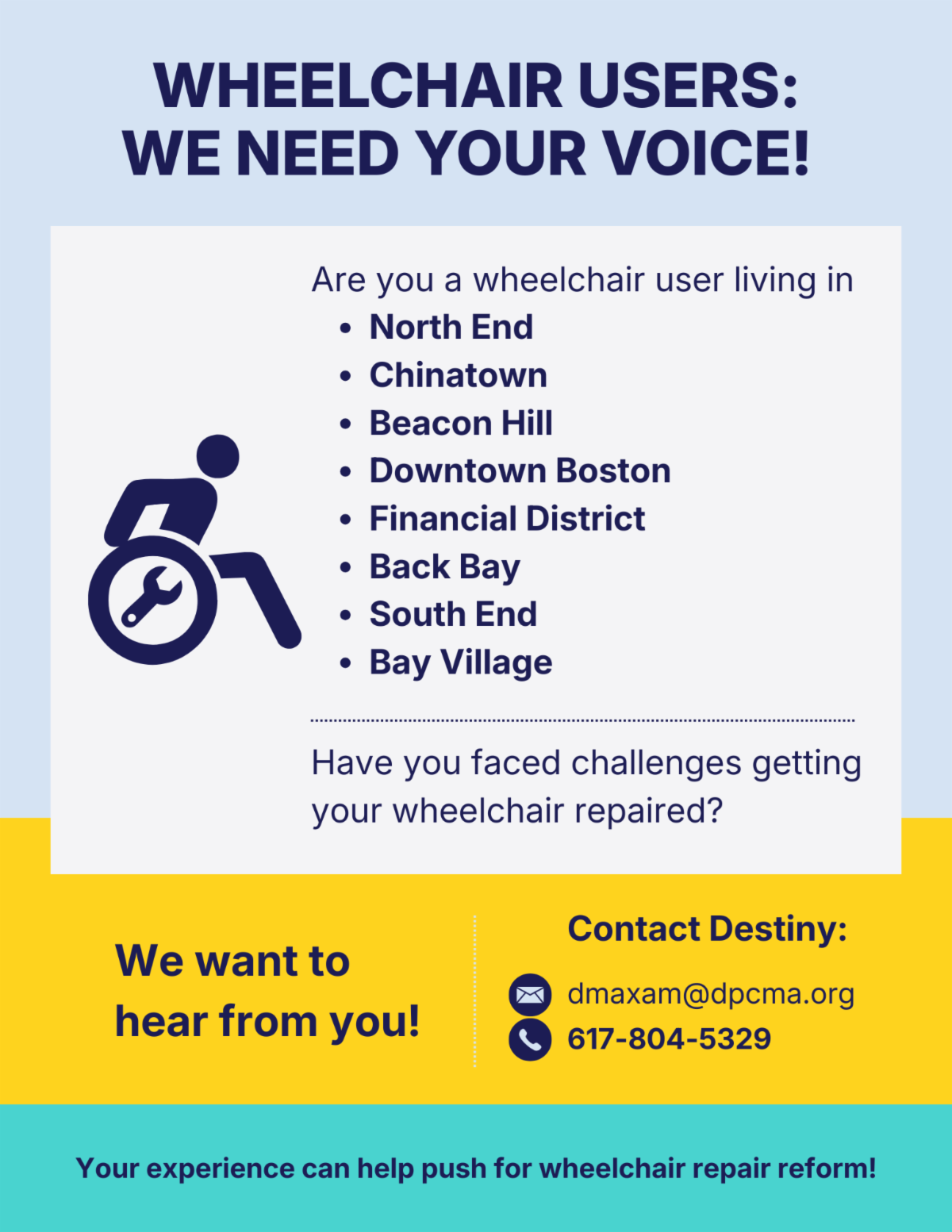
| A couple of months ago, one version of a bill addressing wheelchair repairs passed favorably through two House committees. The other day, the Senate version of the bill (S.210) reported out of committee with a favorable recommendation. The Senate committee made some beneficial changes to the bill so that it now mirrors the House bill, as well as adds a provision that requires loaner chairs to be offered. Since there were changes to the bill, it has been renamed to S.2662. From here, S.2662 moves on to the committee on Health Care Financing. If your legislator is on this committee, now is a great time to reach out to them and express your support. Click here to see the Senators in the Health Care Financing Committee. Are you a wheelchair user living in the North End, Chinatown, Beacon Hill, Downtown Boston, the Financial District, Back Bay, the South End, or Bay Village? Have you faced challenges getting your wheelchair repaired? The Disability Policy Consortium wants to hear from you! Your experience can play a role in the push for wheelchair repair reform. Please reach out to Destiny Maxam at [email protected] or (617) 804-5329. |
|
|
| | Transportation: Air Travel: The Department of Transportation (DOT) will not enforce regulation changes that provide protections for airline passengers who use wheelchairs. However, if you experience issues while flying, please continue to submit complaints to DOT and the airlines themselves. Read more here. The RIDE: There was a recent change to RIDE policies that prohibited drivers from assisting riders with carrying personal items. However, after community advocacy and feedback, RIDE has reversed this policy. Going forward, drivers are once again allowed to help with personal items, including car seats, as long as they can be carried in one arm, in a single trip, and weigh no more than 15 pounds. Items must still fit within your seating area. |
| | Massachusetts Bills to be Aware Of: - “An Act to impose fines on transportation network drivers who discriminate against riders with disabilities using service animals” (also known as H. 2066). This bill would allow transportation network drivers (such as Lyft and Uber drivers) to be fined for discriminating against riders with service animals. The hope is that these fines would reduce the number of drivers that refuse service to people with service animals. Watch testimony on this bill here starting at 00:43:25.
- “An Act to improve Massachusetts home care” (also known as H.4706). This bill creates minimum training and safety standards for home care workers, strengthens workforce protections, and establishes a licensure process for home care agencies. Read more here.
|
| | Rescinded Rulemaking and Guidances: - The U.S. Department of Justice recently withdrew several proposed rules, including two under the Americans with Disabilities Act (ADA). The first rule focuses on the accessibility of equipment and furniture used by state or local governments, or places of public accommodation, such as stores, restaurants, banks, and hotels. The second addressed the accessibility of public rights-of-way, such as sidewalks, curb ramps, and on-street parking.
- The Office of Fair Housing and Equal Opportunity (FHEO) is withdrawing two guidance documents on service and support animals, along with seven others. One guidance, published in 2013, directs managers of HUD-funded housing programs to allow people with disabilities to have an assistance animal. The other guidance, published in 2020, expanded on this by affirming that people with disabilities have the right to request an animal as a reasonable accommodation under the Fair Housing Act. FHEO says these documents are no longer official policy and should not be relied on.
It is important to note that the withdrawal of these rules and guidances does not affect the fundamental requirements of the ADA, Fair Housing Act, or Section 504 of the Rehabilitation Act. All programs, activities, goods, and services must remain accessible to people with disabilities and they still have the right to request a support or service animal as a reasonable accommodation. |
| Advocate Spotlight: Casey Trumbower Sometimes advocacy begins with noticing the everyday moments others might overlook. For Casey Trumbower, it was the day he spilled his coffee while struggling to open the heavy coffee shop door. That frustration made him think about how much harder the same moment can be for people using mobility devices, such as his grandfather and grandmother, and it pushed him to take action. (Read his full story here!) Now a high school senior, Casey is committed to creating more accessible spaces for everyone. He plans to study engineering or applied mathematics, focusing on design and technology that removes accessibility barriers and improves lives. What’s especially impressive is that he began this project in middle school and has continued building on it year after year. Casey’s willingness to notice a problem, speak up, and do something about it reminds us that advocacy can begin in small moments, with small actions. With dedication and perseverance, it can have a big impact. |
| ABLE Accounts Expanding January 1st! Starting January 1, 2026, the eligibility rules for ABLE accounts expand — making them available to many more people with disabilities. Previously, the disability had to begin before age 26. Under the new rule, people whose disability began anytime before age 46 will now qualify. ABLE accounts are tax-advantaged savings accounts for people with disabilities. They allow you to save money for things like education, housing, transportation, healthcare, and other disability-related expenses without affecting eligibility for benefits like SSI or Medicaid. This expansion means more individuals can save for their future and gain greater financial independence. Read more here. |
| | In case you missed it: October’s SCIboston Saturday Education Series by our own Justin Graceffa was on finding, hiring, and managing caregivers, with a focus on the Massachusetts MassHealth PCA program. The webinar was bursting with helpful information! Watch the recording here. Spaulding put out a webinar addressing women’s health and spinal cord injury. Dr. Chloe Slocum and advocate Kimberlee Watts spoke “on the unique biological, psychosocial, and reproductive health needs of women living with spinal cord injury (SCI)”. Watch the recording here. |
| | | National News: Healthcare: They need a ventilator to stay alive. Getting one can be a nightmare, NPR and One Doctor’s Quest to Improve Health Care for People with Disabilities, Tradeoffs Shutdown: Shutdown Ends: Medicare Telehealth Flexibilities Extended Through January 30, 2026, Telehealth Employment: Updated Survey Results on Reasonable Accommodations: Low Cost, High Impact, Job Accommodation Network Medicaid Cuts: States are cutting Medicaid provider payments long before Trump cuts hit, NPR and When the G.O.P. Medicaid Cuts Arrive, These Hospitals Will Be Hit Hardest, NYT Caregiving: Support for Caregivers, Christopher & Dana Reeve Foundation, and Taking Care of Yourself: Tips for Caregivers, NIH and A caregiver's survival guide: Advice from people who've been there, NPR and HHS Backs AI Innovation for America’s Caregivers, HHS Listen: What Donald Trump’s Medicaid cuts mean for caregivers, 1A Watch: The Human Toll of Medicaid Cuts, Harvard Law School Project on Disability |
|
|
| | | | Tuesday, December 16th: - United Spinal Association Webinar: Advocacy Live, from 1:00 – 2:00 pm, ET.
|
| |
|
| | Scholarship Opportunities: - Are you an undergraduate or graduate student pursuing studies related to health and disability? Apply for the AAHD Frederick J. Krause Scholarship on Health and Disability by March 6, 2026. Learn more and apply here.
- Do you have a Spinal Cord Injury or Disorder (SCI/D)? Do you live in Massachusetts, New Hampshire, Maine, Rhode Island, or Vermont? Are you looking to further your education? If so, apply for SCIboston’s Steven F. Riley Memorial Education Scholarship! Scholarships are reviewed semi-annually. Learn more and apply here.
|
| | Join the Disability Policy Consortium’s Board of Directors: The Disability Policy Consortium is looking for someone to join their Board of Directors. They are specifically seeking candidates with experience in finance and strategic planning, and those with a commitment to disability rights and equity. Read the full position description on their website. |
| | From the United Spinal Association: |
| |
|
| Advocacy 101: Interested in expanding your advocacy knowledge? Head over to United Spinal Association’s website to take their first module: Why Advocacy? You’ll learn a history of disability related advocacy, important definitions, and ways to be a more successful advocate. Click here to take the course. It will take 45 minutes or less to complete. |
|
|
Health Equity: United Spinal has compiled a list of resources to help you receive the healthcare you deserve. |
| Join the United Spinal Association Advocacy Hub, an all new Facebook Group for advocates around the country to collaborate and engage with each other. |
|
|
| | We rely on donations, sponsors and grants to fund our advocacy program. If we have made a difference in your life or that of someone you love, consider a donation to allow us to continue to assist others as we assist you. |
| |
|
| | Contact Us SCIboston
2 Rehabilitation Way
Woburn, Massachusetts 01801
(617) 952-5643
[email protected] |
|
|
| SCIboston
2 Rehabilitation Way | Woburn, Massachusetts 01801
(617) 952-5643 | [email protected] |
|
|
| | |
|
|